Serving Bismarck, ND and surrounding areas. (701) 299-5558
Bismarck Concrete & Masonry provides stone masonry, foundation repair, and tuckpointing to Flasher homeowners - with free written estimates, one-business-day responses, and direct experience on Morton County properties where clay soils, persistent wind, and deep frost make masonry quality and footing depth critical to how long any repair actually lasts.
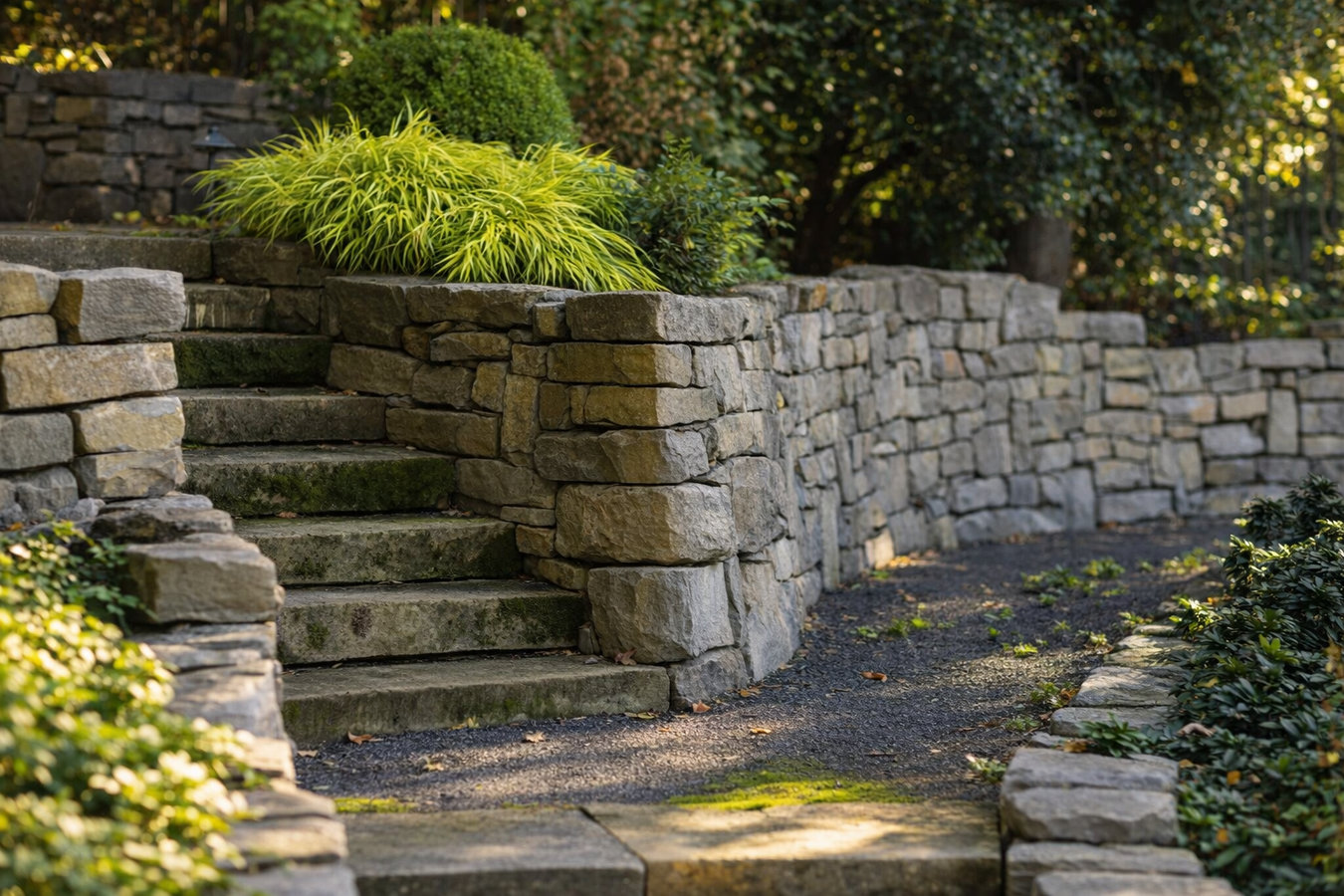
Stone masonry adds durability and character to Flasher homes that need to hold up against the Missouri Coteau's persistent winds and wide temperature swings. Whether you are looking at a stone accent wall, a landscape feature, or a structural stone retaining wall on a sloped lot, our stone masonry work uses footings and mortar rated for North Dakota's freeze-thaw conditions so the finished work stays tight for years rather than shifting apart after a couple of winters.
Flasher homes built in the mid-20th century often sit on original poured concrete or block foundations that have now endured half a century or more of Morton County's deep-frost cycling and clay soil movement. Cracking, bowing, and crumbling mortar joints on basement walls are not cosmetic issues in this climate - they are the first signs of structural movement that gets more expensive to address with every winter it goes unattended.
On older Flasher homes with brick or block chimneys, garage foundations, or exterior masonry walls, recessed mortar joints are one of the most common sources of moisture damage. The freeze-thaw cycle exploits any gap that holds water, and on a Flasher property exposed to southwest North Dakota's winter wind, that damage moves quickly from a minor repoint to a larger reconstruction job if it is left through another season.
Masonry chimneys on Flasher homes face direct wind from the open plateau - and the combination of persistent wind, hail, and deep winter frost erodes crown mortar, loosens brick joints, and cracks clay flue tiles faster than in sheltered locations. A chimney inspection at the end of summer is the most straightforward way to catch damage from the previous winter and hail season before it compounds through another freeze cycle.
Most Flasher properties include a driveway, a detached garage pad, and concrete around outbuildings - all of it exposed to Morton County's frost depth and the expansive clay soil that pushes up from below when it freezes and saturates. Cracking and settlement in these slabs are steady maintenance needs here, and addressing them while they are manageable is far less disruptive than waiting until a slab has heaved to the point where full replacement is the only option.
On Flasher properties with grade changes - near outbuildings, drainage channels, or sloped yard areas - soil erosion from spring snowmelt on the Missouri Coteau's rolling terrain is a recurring problem. A masonry retaining wall with footings below the frost line and proper drainage backfill holds that soil through repeated freeze-thaw cycles in a way that timber or lightweight modular systems cannot sustain over multiple North Dakota winters.
Flasher sits on the Missouri Coteau, a high rolling plateau in Morton County that is known for persistent wind, wide temperature swings, and soils with a high clay content. Clay soil is one of the most demanding materials a foundation or concrete slab can sit on - it expands when wet and contracts when it dries, pushing and pulling on any structure anchored in it throughout the year. Add a frost line that reaches four feet underground in central and southwestern North Dakota, and you have soil conditions that test every masonry joint, concrete edge, and footing on the property. Most of Flasher's housing stock was built during the mid-20th century, before modern vapor barriers, expansion joint standards, and frost-depth requirements were routinely applied to residential construction. That combination of aging materials and demanding soil conditions is the backdrop for nearly every masonry repair call we receive here.
Hail is a significant seasonal factor in this part of North Dakota. Severe thunderstorms tracking across the open plains from late spring through summer can drop large hail that chips stone veneer, cracks chimney caps, and spalls brick faces on a single pass. Morton County sits in a hail corridor, and homeowners in Flasher should treat a post-storm masonry inspection as routine maintenance - not an emergency. Damage that looks minor after a summer storm tends to absorb winter moisture and freeze-expand into a larger problem by the following spring. For long-term Flasher homeowners who plan to stay in their homes, the math is straightforward: preventive masonry maintenance costs less than restoration after years of deferred work.
Our crew works throughout Flasher regularly, and we understand the local conditions that affect masonry contractor work here. For permits on structural masonry projects in Flasher, homeowners work with either the City of Flasher or Morton County depending on project scope - we confirm which authority applies before work begins and handle the application process so homeowners are not managing that on their own.
Flasher is located about 60 miles southwest of Bismarck on the open plateau of the Missouri Coteau. The drive out from our Bismarck base is direct, and we make it regularly for homeowners throughout the Flasher area. The community is small - a few hundred people - and most properties are single-family homes on individual lots, many with detached garages and outbuildings. Flasher Public School is the central institution in town, and the community has the tight-knit character of a small agricultural city where people know their neighbors and take their properties seriously. Farming and ranching are the economic backbone here, and the properties we work on range from in-town homes near the school to rural acreage parcels on the edges of town.
We also regularly serve Wilton to the north and Baldwin to the northeast, covering this range of rural central and southwestern North Dakota communities as part of our regular territory.
Reach us by phone or through the contact form and describe what you are seeing. We reply within one business day and schedule a site visit at a time that works for you - Flasher is within our regular service area and we make the drive without treating it as an out-of-the-way job.
We walk the property, evaluate the masonry and concrete condition, and look at soil and drainage factors that affect repair durability. You receive a written estimate at no cost - cost and scope are clear before you decide whether to move forward.
Masonry work in Morton County requires temperatures consistently above 40 degrees Fahrenheit for mortar to cure correctly - we schedule accordingly and do not cut that corner. Permit applications are handled by our crew when the project requires them.
When the job is complete, we walk you through what was done and share any maintenance steps worth knowing - such as when to apply concrete sealer or what to look for on a chimney after the first hard winter. You leave with a clear picture of the work and what to watch for going forward.
We serve Flasher and Morton County with free written estimates, one-business-day responses, and a crew that makes the drive to southwestern North Dakota - not just jobs near the city.
Flasher is a small city in Morton County, North Dakota, sitting on the rolling hills of the Missouri Coteau about 60 miles southwest of Bismarck. The town has a population of a few hundred people, and the local economy is built on farming and ranching - wheat, sunflowers, and cattle are the primary products in this part of the county. Most residents own their homes and have deep roots in the area, which gives Flasher the character of a community where long-term investment in property upkeep is the norm. Flasher Public School serves as a central institution for the town, and the Flasher Bulldogs are a point of local pride - in a community this small, nearly every family has a connection to the school. More information on the broader county is available through the U.S. Census QuickFacts page for Flasher.
The housing stock in Flasher is predominantly older - most homes were built in the mid-20th century during the region's agricultural growth period, and they reflect the wood-frame construction standard across the northern plains. Full basements are common given the frost depth requirements in Morton County. The combination of aging foundations, clay-heavy soils, and the demanding climate of the Missouri Coteau means that foundation repair, tuckpointing, and concrete maintenance are recurring needs for homeowners here. Neighboring communities Wilton and Mandan sit in the broader region we serve, and homeowners throughout this part of North Dakota benefit from the same expertise in deep-frost masonry we bring to Flasher.
Build walls that hold soil, prevent erosion, and add curb appeal.
Learn MoreEnhance any surface with beautiful, low-maintenance stone veneer.
Learn MoreConstruct solid concrete block walls for security and lasting durability.
Learn MoreInstall strong block foundation walls built to handle North Dakota conditions.
Learn MoreCall us today or submit a request online - we serve Flasher and the surrounding Morton County area with free written estimates and one-business-day responses.